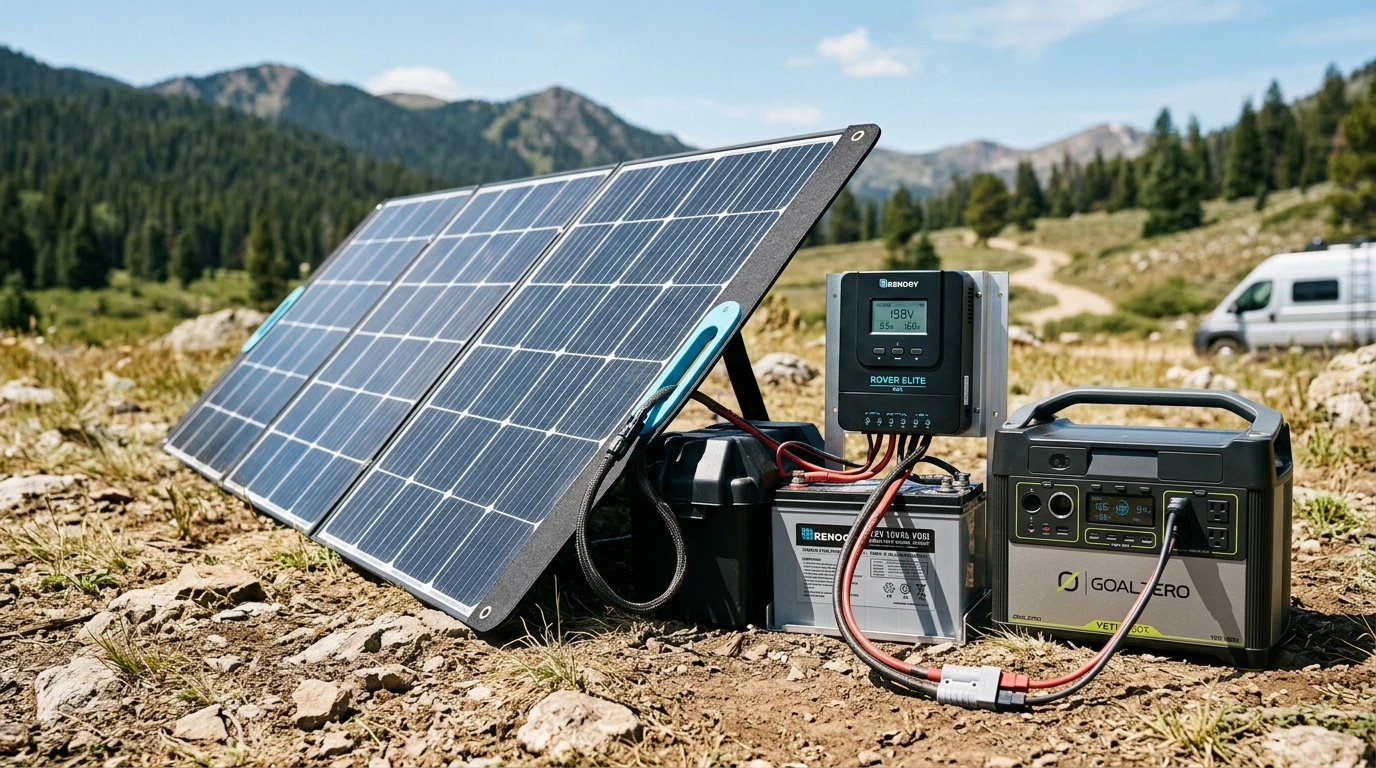
What is a Solar Powered Battery Charger?
A solar powered battery charger harnesses sunlight through photovoltaic (PV) semiconductor cells to generate direct current (DC) electricity specifically calibrated to replenish or maintain secondary rechargeable batteries.
Unlike general solar generators or grid-tied home arrays, dedicated solar battery chargers are engineered with specialized voltage regulation and reverse-current blocking hardware. They range from compact 5W–20W trickle maintainers designed to counteract parasitic battery drain in stored vehicles to high-output 50W–200W foldable solar kits capable of rapidly charging deep-cycle marine, RV, and off-grid energy storage banks.
Core Electrical Principles & Key Components
A reliable solar charging setup relies on several synchronized electrical components to deliver safe, efficient charging without damaging battery plates or chemistries:
- High-Efficiency Photovoltaic Cells: Modern portable chargers utilize monocrystalline silicon cells (or SunPower Maxeon contact cells) encapsulated in durable ETFE polymers, achieving 21%–23.5% solar conversion efficiency even under partial cloud cover.
- Blocking Diodes (Anti-Discharge Protection): When darkness falls, a solar panel's voltage drops to zero. Without an integrated Schottky blocking diode, the connected battery would discharge backward through the solar cells. Every quality maintainer incorporates low-forward-voltage diodes to prevent nocturnal power loss.
- Charge Controllers (PWM vs. MPPT):
- Pulse Width Modulation (PWM): Ideal for small maintenance systems (under 50W), holding voltage steady at absorption and float setpoints.
- Maximum Power Point Tracking (MPPT): Essential for panels 50W and higher, dynamically adjusting voltage and current ratios to harvest up to 20%–30% more energy during cold mornings or variable weather.
- Multi-Stage Smart Charging: Quality controllers apply three-stage charging algorithms—Bulk (constant current up to ~80% capacity), Absorption (constant voltage tapering current to 100%), and Float / Maintenance (steady 13.4V–13.8V maintaining 100% capacity without boiling electrolyte).
Primary Applications & Real-World Use Cases
Solar battery chargers solve critical power challenges across four major domains:
- 1. Automotive, Marine & RV Trickle Maintenance: Vehicles, boats, motorhomes, and motorcycles left idle suffer continuous parasitic draw from alarms, clocks, and engine control units (ECUs), as well as natural lead-acid self-discharge (3%–5% per month). A 10W–20W solar trickle maintainer mounted on a dashboard or cabin roof prevents sulfation, quadrupling battery longevity.
- 2. Off-Grid & Agricultural Infrastructure: Powering remote 12V applications such as automated pasture gates, electric livestock fencing, telemetry sensors, deer feeders, and shed lighting where running mains electricity is cost-prohibitive.
- 3. Outdoor Recreation & Portable Power Stations: Foldable solar arrays equipped with USB-C Power Delivery (PD 65W/100W), regulated 12V DC barrel jacks, and Anderson/XT60 connectors enable rapid charging for power banks, drones, GPS devices, camping fridges, and portable LiFePO4 power stations.
- 4. Emergency Preparedness & Backup Reserves: Keeping standby generator starting batteries, ham radio power packs, and domestic emergency kits fully topped regardless of utility grid failures.
How to Size Your Solar Battery Charger
Selecting the correct wattage depends on your operational objective and battery capacity:
- Trickle Maintenance (12V 40Ah–100Ah Lead-Acid): 5W to 15W panel. Offsets phantom drain (50mA–150mA) and self-discharge without needing a complex multi-stage controller.
- Slow Recovery / Weekend Top-Up (12V 50Ah–100Ah): 30W to 60W panel with a dedicated 5A–10A PWM controller. Delivers 2A–3.5A of charging current during peak sun.
- Daily Off-Grid Cycling (12V 100Ah+ AGM/LiFePO4 or Power Station): 100W to 200W panel paired with an MPPT charge controller. Capable of delivering 5A–15A of sustained charge current, replenishing 30–60Ah daily.
Technical Guidelines & Battery Chemistry Compatibility
Always ensure the charger or charge controller profile matches the specific chemistry of your battery:
- Flooded Lead-Acid / Sealed AGM: Requires 14.4V–14.7V absorption and 13.6V float.
- Gel Batteries: Sensitive to overvoltage; max charging voltage must not exceed 14.2V to prevent bubble formation in the silica gel electrolyte.
- Lithium Iron Phosphate (LiFePO4): Requires a dedicated lithium profile (14.2V–14.6V CV with no desulfation pulse) and integrated low-temperature charge cutoff below 0°C (32°F).
Related Guides & Further Reading
- Explore our in-depth analysis on Home Battery Storage & LiFePO4 Chemistry.
- Learn the fundamental physics of photovoltaics in Solar Basics.
- Discover compact plug-and-play generation in Plug-in Solar & Balcony PV.
- Check out the Solar Energy Advantages Blog for additional articles on solar advantages and portable PV innovations.
- Questions regarding specific charging setups? Reach out to our technical research team at hello@think-solar-power.com.