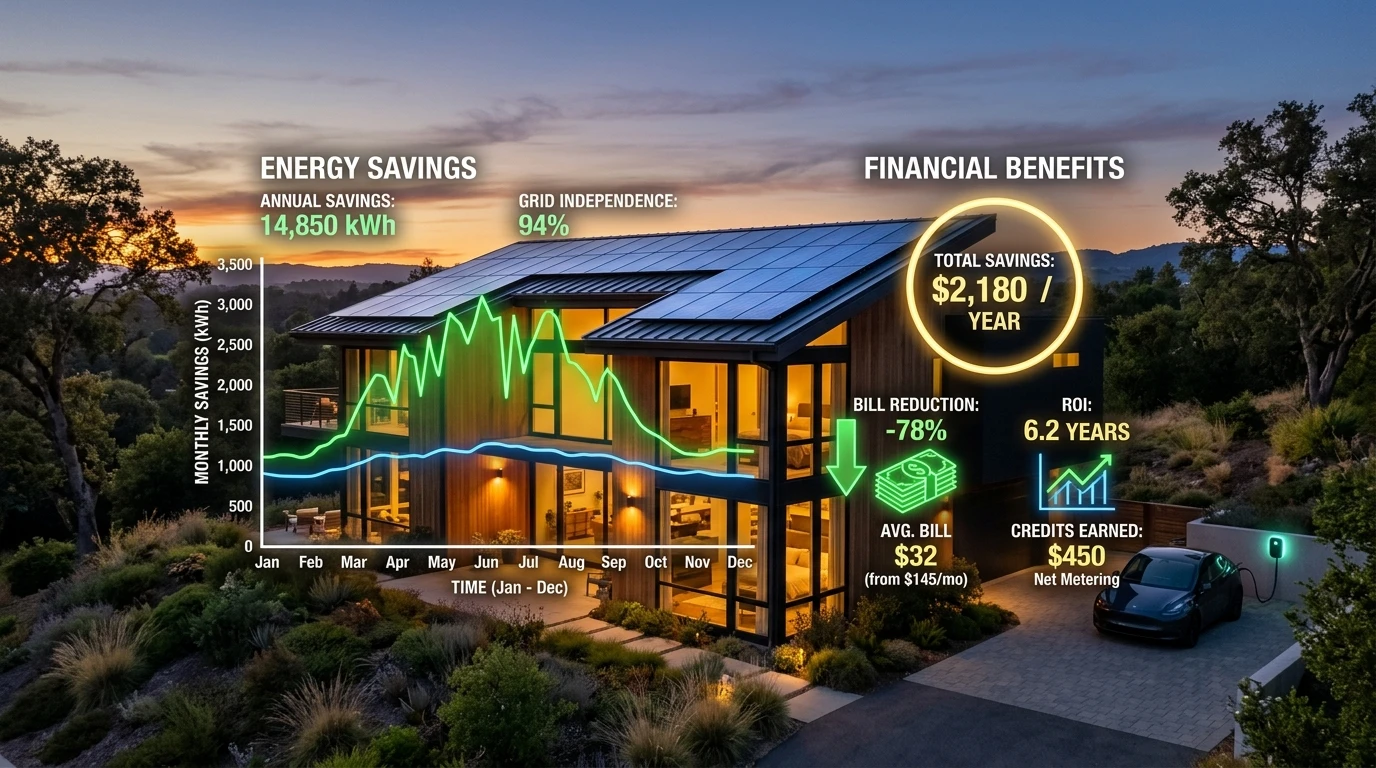
Maximize Your ROI: How Much Can You Actually Save with Solar?
← Return to Portal
Financial Economics · Bill Reductions5 Min Read

Maximize Your ROI: How Much Can You Actually Save with Solar?

By Think Solar Power Editorial & Research DeskReviewed under IEC 61215/61730 & IEEE Empirical StandardsUpdated Oct 20, 2026

Analyze the 2026 financial dynamics of residential solar: self-consumption ratios, dynamic time-of-use export arbitrage, and 4–7 year payback horizons.

Typical Bill Cut
65% – 90% Reduction
Payback Horizon
4.5 – 7.5 Years
Internal Rate of Return
13% – 19% Tax-Free Yield

2026 Hardware & Performance Benchmarks

Empirical Comparison
Technical ParameterLegacy Baseline (2020–2023)2026 Industry Standard
4 kWp System (Solar Only)35% Self-Use · ~£520/yr SavedSmart Load Shifting · ~£680/yr Saved
6 kWp + 10 kWh LFP BatteryFixed Export · ~£950/yr SavedDynamic ToU Arbitrage · £1,250–£1,550/yr
8 kWp + 15 kWh LFP + EV/Heat PumpStandard Tariff · ~£1,300/yrFull HEMS Optimization · £1,850+/yr
Effective Levelized Cost (LCOE)£0.24 – £0.28 / kWh (Grid)£0.045 – £0.065 / kWh (30-Yr Solar)

The 2026 Financial Breakdown

A properly sized residential solar and storage installation (typically 5 kWp to 8 kWp of N-Type PV paired with 10 kWh of LFP storage) reduces annual grid electricity expenditure by 65% to 90%+. Across typical UK and European households facing volatile retail grid rates and network standing charges, this translates to verified annual savings between £900 and £1,850+.

Levelized Cost of Energy (LCOE) & Payback Timelines

When amortized across a conservative 25-year operational window, the Levelized Cost of Energy (LCOE) for residential rooftop solar sits between £0.045 and £0.065 per kWh—roughly one-fourth the cost of retail utility electricity. With zero-rate VAT treatment on residential solar and battery storage in key markets and lower $/Wh lithium-iron-phosphate pack prices in 2026, turnkey systems routinely reach full capital payback in 4.5 to 7.5 years, delivering an unlevered, tax-free equivalent yield of 13% to 19% APR.

Three Levers to Maximize Financial Return

  • 1. Time-of-Use Peak Export Arbitrage: Rather than exporting midday solar at low flat rates, smart hybrid inverters hold daytime generation in your battery and force-discharge to the grid between 4:00 PM and 7:00 PM, capturing premium evening export tariffs (often £0.22–£0.35/kWh).
  • 2. Overnight Off-Peak Winter Charging: During dark December and January weeks, your battery charges automatically from the grid between 11:30 PM and 5:30 AM at off-peak EV rates (~£0.07/kWh) and runs your home all day, avoiding £0.26+/kWh daytime import rates even without sunshine.
  • 3. Thermal & EV Load Shifting: Diverting surplus midday watts into an EV charger (via 6A–32A solar modulation) or heat pump hot water cylinder replaces expensive fossil gas or petrol miles with zero-marginal-cost photons.
Interactive 2026 Sizing Model • N-Type TOPCon + LFP

Solar & Battery Yield Estimator

6.0 kWp (13 × 450W Panels)
2.0 kWp (Compact)6.0 kWp (Standard Home)12.0 kWp (Large 3-Phase)
10.0 kWh LFP
0 kWh10 kWh (Optimal Daily Buffer)20 kWh (Full Autonomy)
4,200 kWh / yr
2,000 kWh (Flat / Low)4,200 kWh (3-4 Bed Home)10,000 kWh (EV + Heat Pump)
Estimated Annual Financial Return
£1,484/ year saved + exported

Includes ~£210/yr from off-peak overnight LFP tariff arbitrage

Annual PV Yield
5,760 kWh
Self-Consumption
48%
Payback Horizon
~7.7 Years
Carbon Displaced
1.19 tCO₂/yr

Frequently Asked Technical Questions

Yes. Homeowners combining a 6kWp+ solar array with a 10kWh–15kWh LFP battery on a dynamic time-of-use tariff regularly offset 100% of their annual electricity charges—including daily standing charges—by importing cheap overnight power in winter and exporting stored solar energy during high-rate 4 PM–7 PM evening peak windows.

Continue Exploring 2026 Solar Guides