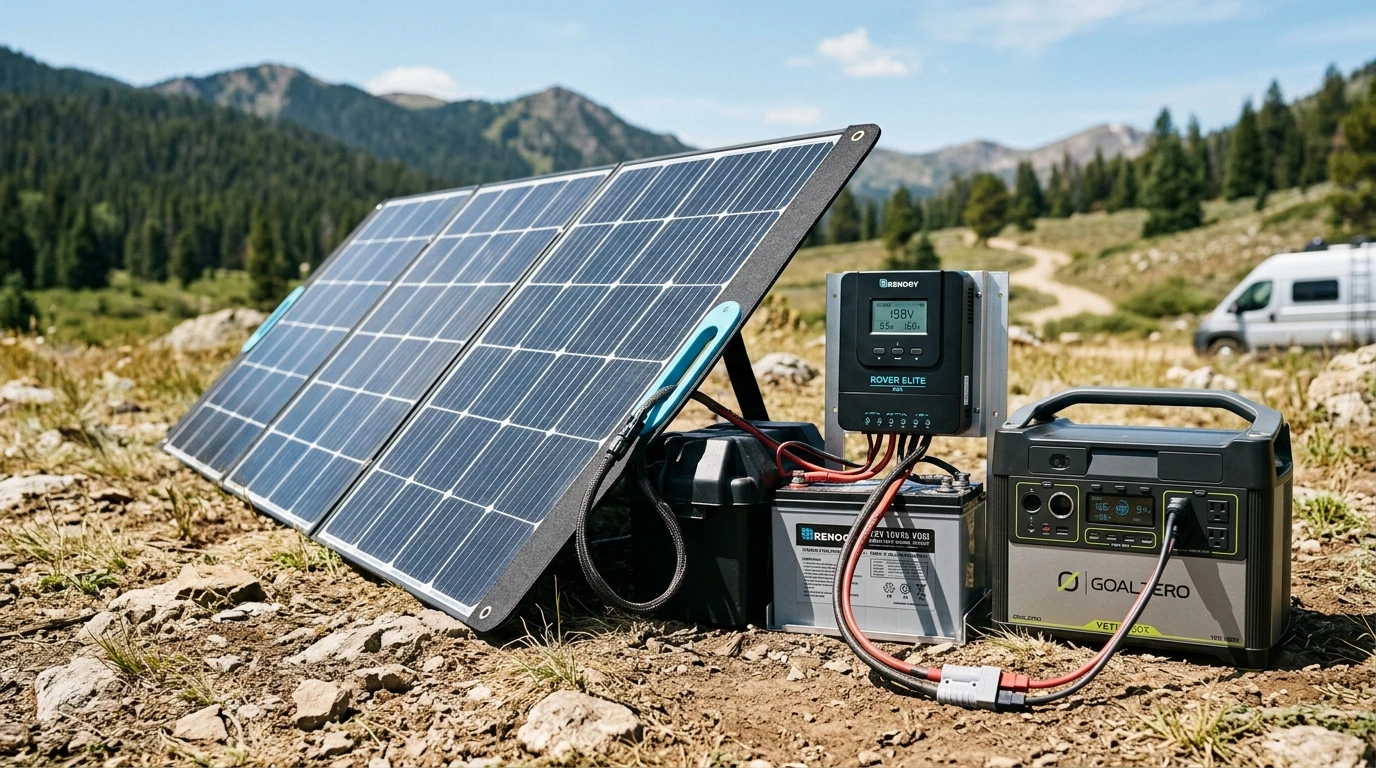
What is a Solar Powered Battery Charger?
A solar powered battery charger harnesses sunlight through photovoltaic (PV) semiconductor cells to generate direct current (DC) electricity specifically regulated to replenish, balance, or maintain secondary rechargeable batteries.
Unlike grid-tied rooftop arrays, dedicated solar battery chargers incorporate specialized DC-DC voltage regulation, chemistry-specific absorption/float algorithms, and reverse-current protection. In 2026, these systems span from ultra-compact 10W–25W N-Type ETFE dashboard maintainers that eliminate parasitic drain in stored vehicles to 200W–400W foldable monocrystalline arrays and dual-input DC-DC + Solar MPPT chargers for campervans, yachts, and off-grid telemetry stations.
Core Electrical Principles & 2026 Hardware Architecture
A reliable solar charging system relies on four synchronized electrical stages to deliver fast energy recovery without damaging battery plates or lithium anodes:
- N-Type Monocrystalline & ETFE Lamination: Modern portable and marine chargers encapsulate N-Type TOPCon or back-contact cells beneath textured ETFE (Ethylene Tetrafluoroethylene) fluoropolymer film rather than cheap PET plastic. ETFE resists UV delamination, salt-spray corrosion, and hail while transmitting 95%+ of incident light.
- Low-Loss Ideal Blocking Diodes (MOSFET Anti-Reverse): At night, a solar panel's open-circuit voltage drops to zero. Modern chargers replace legacy high-drop silicon diodes with active MOSFET ideal diodes, preventing any nocturnal reverse current drain from the battery with near-zero voltage drop during daylight charging.
- PWM vs. Smart MPPT Charge Controllers:
- Pulse Width Modulation (PWM): Cost-effective for small 10W–30W trickle maintainers where panel voltage closely matches battery voltage.
- Maximum Power Point Tracking (MPPT): Essential for arrays 50W and above. By tracking the panel's peak power voltage ($V_{mp}$, typically 18V–40V) and buck-converting it down to battery voltage (12.8V–14.6V) with boost current, MPPT harvests 20% to 35% more energy—especially on cold winter mornings or under partial shade.
- Dual-Input DC-DC + Solar MPPT Chargers: The 2026 standard for RVs, overlanders, and marine vessels combines a vehicle smart-alternator DC-DC charger and a solar MPPT controller into a single unit—prioritizing free solar watts while driving and seamlessly blending alternator power when needed.
Primary Applications & Real-World Use Cases
Solar battery chargers solve critical off-grid power challenges across four primary domains:
- 1. Automotive, Classic Car, Marine & RV Trickle Maintenance: Modern vehicles, boats, and motorcycles left parked draw continuous parasitic current (30mA–120mA) for security immobilizers, telematics, and ECUs, compounded by natural lead-acid self-discharge (3%–5% per month). A 10W–25W OBD-II or alligator-clip solar maintainer prevents lead sulfate crystallization, extending starter battery lifespan by 2x–3x.
- 2. Off-Grid Agricultural & Telemetry Infrastructure: Powering remote 12V/24V installations such as automated pasture gates, electric livestock fencing, LoRaWAN weather stations, borehole pumps, and security cameras where trenching mains cable is cost-prohibitive.
- 3. Portable Power Stations & USB-C PD 3.1 Field Gear: Folding solar blankets equipped with XT60/Anderson high-current ports and direct USB-C Power Delivery 3.1 (up to 140W) charge laptops, drones, satellite communicators, 12V compressor fridges, and portable LiFePO4 power stations simultaneously.
- 4. Emergency Preparedness & Standby Backup: Keeping home backup generator starter batteries, VHF/HF emergency radio packs, and sump pump battery backups at 100% State of Charge during prolonged grid blackouts.
How to Size Your Solar Battery Charger
Selecting the correct wattage depends on your daily amp-hour (Ah) or watt-hour (Wh) deficit and peak sun hours (PSH):
- Trickle Maintenance (12V 45Ah–110Ah Starter Battery): 10W to 20W panel. Offsets 50mA–150mA parasitic vehicle drain and self-discharge year-round.
- Weekend Recovery / Light Auxiliary Loads (12V 60Ah–100Ah Leisure Battery): 50W to 100W panel with a 10A MPPT controller. Replenishes 15Ah–35Ah daily for LED lighting, bilge pumps, and phone charging.
- Continuous Off-Grid Cycling (12V 100Ah–300Ah LiFePO4 + 12V Fridge): 200W to 400W solar array paired with a 20A–40A MPPT controller, delivering 70Ah–140Ah (900Wh–1,800Wh) per sunny day.
Technical Guidelines & Chemistry Voltage Profiles
Always configure your charge controller to match your exact battery chemistry:
- Flooded Lead-Acid / Sealed AGM: Absorption at 14.4V–14.7V, Float at 13.5V–13.6V, with temperature compensation (-3mV/°C/cell).
- Gel Lead-Acid: Sensitive to gas pocket formation; cap Absorption at 14.1V–14.2V and Float at 13.5V–13.8V.
- Lithium Iron Phosphate (LiFePO4): Dedicated lithium CC/CV profile (14.2V–14.6V absorption, 13.5V resting float, Desulfation Equalization DISABLED) with mandatory 0°C (32°F) low-temperature charge protection.
Related Guides & Further Reading
- Explore our in-depth analysis on Home Battery Storage & LiFePO4 Chemistry.
- Learn the fundamental physics of photovoltaics in Solar Basics.
- Discover compact plug-and-play generation in Plug-in Solar & Balcony PV.
- Check out the Solar Energy Advantages Blog for additional articles on solar advantages and portable PV innovations.
- Questions regarding specific charging setups? Reach out to our technical research team at hello@think-solar-power.com.